
Implementing ERC-3643 With Valence’s Modular Kernel
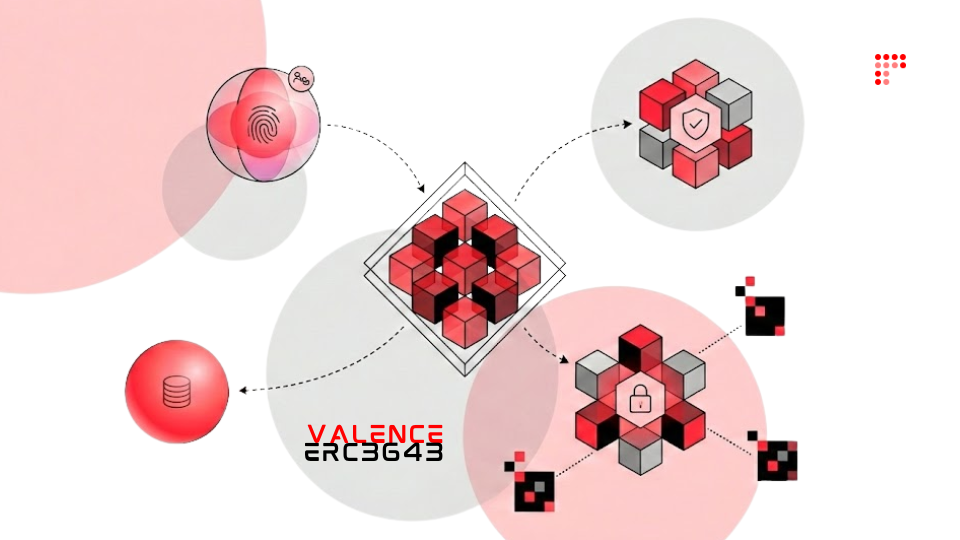
In the race to put regulated assets on public blockchains, the hard part isn’t “tokenization.” It’s everything regulators and market operators expect around the token: eligibility, transfer controls, recoverability, governance, and upgrade discipline—without turning the codebase into a brittle monolith.
That’s the design space ERC-3643 was built for. The standard (known as T-REX) defines a suite of contracts—identity, registries, and modular compliance—that keeps tokens ERC-20 compatible while enforcing permissioning at transfer time. The result is a permissioned asset that can still live on permissionless rails.
From “a contract” to “a system”: why Valence matters
This is where Valence comes in. FeverTokens-Labs’s framework is built on the EIP-2535 Diamond pattern, but with a kernel that treats functionality as installable, versioned modules (“orbitals”), each with explicit exported selectors and namespaced storage (ERC-7201) to reduce upgrade risk. In other words: upgrades are structured, not improvised.
That architecture is a natural fit for ERC-3643, which is itself a composition of moving parts. The compliance engine evolves. Identity logic evolves. Administrative controls evolve. A one-piece contract struggles under that weight; a governed, modular system doesn’t.
The Valence implementation of ERC-3643: composable compliance by design
The Valence example implementation (Valence/contracts/examples/erc3643-token at main · FeverTokens-Labs/Valence) takes the standard’s core intuition—compliance as a first-class, on-chain primitive—and expresses it the Valence way: as modules you can install, upgrade, and reason about independently, while the diamond address remains the stable entry point for integrators.
Conceptually, ERC-3643’s building blocks map cleanly onto Valence’s module lifecycle:
- Token behavior remains ERC-20-like for wallets and venues, but transfer execution is gated by compliance checks.
- Identity & eligibility are separated from token logic, reflecting the standard’s “verified participants” model.
- Compliance rules are modular by nature (the official suite even includes “modular compliance” contracts), making them ideal candidates for orbitalized components rather than hard-coded conditions.
Valence’s kernel-centric approach adds a practical advantage that institutions care about: you can upgrade the compliance perimeter without redeploying the asset, while keeping explicit control over who can install/upgrade modules and what selectors are exposed.
Why this is more than an engineering preference
For tokenized RWAs, the upgrade path is not a technical footnote, it’s a governance commitment. Rules change. Jurisdictions reinterpret. Transfer restrictions get refined. If your only upgrade option is “ship a new token,” you’ve reinvented operational risk.
By pairing ERC-3643’s regulated-token blueprint with a kernel-orchestrated modular framework, Valence effectively turns a compliance token into something closer to a maintainable market infrastructure component: auditable modules, collision-resistant storage patterns, and a controlled lifecycle for change.
That’s the quiet shift happening in institutional on-chain finance: less obsession with “the token standard,” more focus on the system standard: how upgrades happen, how controls are enforced, and how complexity stays legible over time.


- © 2025 FeverTokens
- 38 rue Jean-Mermoz, 75008, Paris, France